Thursday, October 8, 2009

New blog guest

My former test-driver, Barney, is no longer with us.  He passed away July 28 after being our buddy for 4 years.  We miss him very much.  We decided very quickly that we needed another cat, so we found Brownie.  He is a kitten, though he's grown so much in the last few weeks you would not think so.  Here are a few pictures taken in the last week.  He does not yet understand the concept of sleeping in a cat bed, but at least he is touching it in this shot.


His favorite thing to do is burrow in the magic blanket and make air biscuits.

Barney had no interest in yarn or fiber, but Brownie is a big fan of both.  


Saturday, September 12, 2009

Knitting as a procedural memory

The person who I consider to be the most famous psychology human subject passed away last December, at the age of 82, after being studied since he was 27 years old. It was at that time in 1953 that H.M. (as he was known until his death) lost his ability to store new memories as a result of a surgical procedure that was done to treat severe epilepsy. While the surgery was successful in preventing the seizures that had incapacitated H.M., it had a devastating effect on the rest of his life. It was thought at first that he was no longer able to form any new memories, but the work of Brenda Milner revealed that he was able to form some types of new memory, just not the kind that we usually think of. He could learn new skills, but he would not be able to say when and where he learned the skill or even that he had the skill. It would only be revealed in his actions.

When H.M. died, and it was revealed that his initials stood for Henry Molaison, it was also revealed that his brain was to be studied at UC San Diego, and that the public would be able to view the process and the resulting brain images at the Brain Observatory (see description of the HM project here). I was delighted to find the link to a NOVA episode that featured this work. It's definitely worth 10 minutes of your time! You can get there by clicking here: NOVA

I'm sure that if Mr. Molaison had been taught to knit after his surgery, he would have retained that skill and made some pretty awesome projects!

Thursday, July 16, 2009

new box


My mumma gets a new toy and all there is for me is this box.

New (and last) wheel


A Schacht Matchless!


It's a bit different...

hand-all hat


Here is a hand-dyed, hand-spun and hand-knit hat that I really like.
It might be some of the last yarn I spin on the old Babe's wheel!

Sunday, June 28, 2009

new twine


It was not twine when I made the purchase.

Wednesday, June 10, 2009

Maine Knuts


Some of the knuts visited Harpswell, ME for the weekend. We had a great time!

Tuesday, April 28, 2009

Melville Workshop Musings

I’ve been knitting like a fiend for 23+ years, but it is only in the last 3 days that I have been to a knitting workshop. Not just any ‘ole workshop, but one run by Sally Melville. The LYS that I frequent most often was offering the workshops, and I decided to rope a friend into attending. The only one that fit both our schedules was called Knit to Fit and Flatter and required us to produce paper doll replicas of our own bodies. This form of reality took multiple days to process and should be on every health-conscious person’s refrigerator. It might also help if it was posted at every donut/coffee shop between one’s house and workplace. Anyway, I recovered from that shock in time to listen to some instructions, which included producing clothes for our doll selves. It was good to get covered up and to learn that certain styles can be made to be flattering. I went home and dragged out all the sweaters that I wear frequently and discovered that these were the ones that “followed the rules”. I now feel totally empowered to make sweaters that will look appropriate on me and I will hesitate less to get rid of the sweaters that I love to look at, but not wear. I can’t promise I will actually get rid of these, I’m just leaning that direction. Small steps.

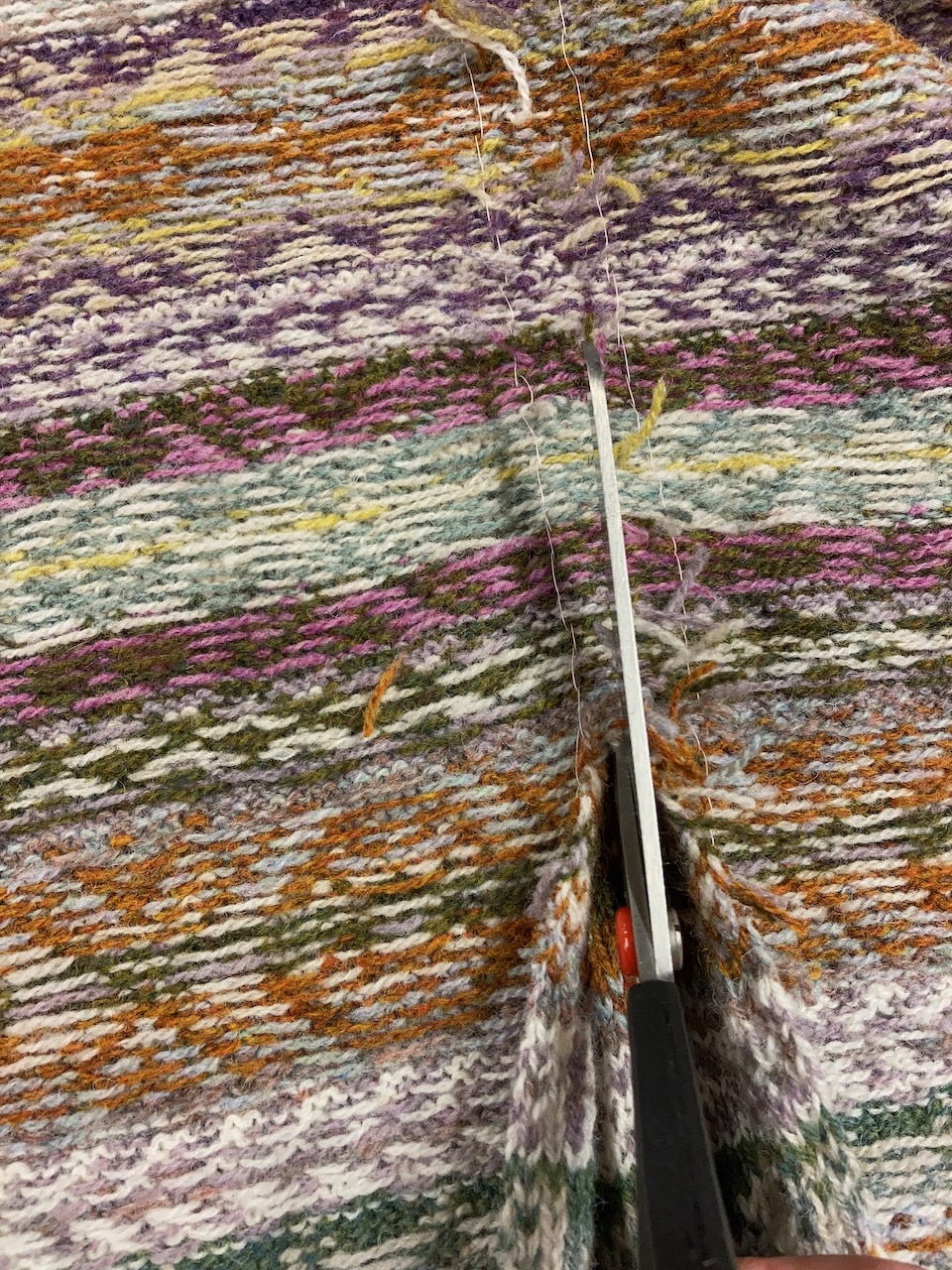
The best part was to return for another workshop a few days later with some of those rule-abiding sweaters, plus one that I knew could look better on me. It was made prior to my new understanding of the rules. I thought it would prompt Sally to say, “see what I mean”? She did say something like that, and then asked for some scissors to show me how to fix it. I don’t have a before close-up, but here is the aftermath of the sweater modification. Perhaps my other rule-breaking sweaters will meet a similar fate. I’m very excited to bind off the raw edge and add it to the rule-abiding pile.


In general the workshops were productive and very fun. I hung out with 2 good friends at the first one (I only roped one into it, the other came under her own volition). We all bonded by enduring the distress of viewing our paper doll selves. Here is mine, fully and appropriately dressed in my ideal short-length unfitted sweater and an A line skirt. I don’t actually own such a skirt, but that’s what I should be wearing. Maybe not those colors.

Sally’s view is that patterns should be more flexible than they are, with indications of where to lengthen or shorten the body or to adjust the sleeve to fit better. This principle is applied in the Knitting Experience series, but it’s dialed up a few notches in Mother-Daughter Knits, with the first chapter all about the fit and flatter material that was covered in the Paper Doll Self workshop. I know that this book is going to be an important reference for my projects going forward. I don’t generally follow patterns, but I may be convinced to follow some from this book. It helps to have seen some of the sweaters, modeled by Sally herself. More info about Sally is at her website: http://www.sallymelvilleknits.com/index.html
Thanks, Sally, for the inspiration and the useful information.

Sunday, April 12, 2009

mahogany vest progress


Here is the vest in progress. The idea is to have a front that overlaps and ties on one side, with a very simple lace edge design.

Thursday, April 9, 2009

Not a pipe-dream


As part of the no-new-twine-in-2009 effort, I have been raiding the stash and coming up with some rather random small projects.  People who don't usually get a knitted item from me for their birthday have not been so lucky this year.  This is a hat for one of the plumber brothers.

Tuesday, March 31, 2009

Mahogany?

I experimented with some Knit Picks Palette in Tan. I originally got the yarn to make a vest, but it wasn’t the right color tan, so it was sitting around doing nothing. It was a convenient target at the beginning of the dyeing bout.


I used “cranberry”, “butterscotch” and “mahogany” ProChem One-Shot acid dye for these skeins. This is when mahogany hinted at its leanings toward rosey. Husband calls this color “autumn leaves”. Evidence gathered over 17 years of coexistence suggests that we have different sets of color receptors (he’ll say grey when I say purple). Despite this, I can see where he gets that idea.


Now knowing and liking “mahogany”, I dove into a bigger, more risky endeavor. Oogyknitter gave me 2 huge skeins of undyed Kid Silk Haze, an estimated 1800 yards of dreamy yarn. One does not just throw dye at such a prize before considering carefully the consequences. So it took me a few months to decide to dye the kid silk haze in combination with some Knit Picks lace weight wool/silk blend yarn, with the idea of stranding them together for a vest or some such project. I even did a swatch to see if the stranding would be feasible before I did the dyeing.

Here is the kid silk haze getting dyed.

And here is how both yarns looked when they were finished. Rosey!

I recruited an eager accomplice for the Dyeing Bout of March 2009. Nova brought over a truckload of wool from various sources and we spent the afternoon in colorful bliss. Check her blog for spinning/knitting progress.

The bout ended with the end of our Spring Break. I know, I should have been grading lab reports…Stay tuned for how the stranded rosies look.

Thursday, March 5, 2009

Niece's scarf


In the continued effort to use up my endless supply of yarn I am happy to report that another finished object has left the premises!  This is hand dyed merino worked in a simple entrelac design (simple once you make 3-4 unsuccessful attempts at the second row). 


Thursday, February 5, 2009

Psi Hat

This is another hat made from the big wheel of wool. If you use your imagination, you can see the Greek letter psi repeated in the pattern, or maybe you see IgG antibodies like my geek husband.

Wednesday, January 21, 2009

Knitting as an Effort-Based Reward System

I’ve heard many knitters say that they use their hobby/craft as a type of therapy. I often joke that yarn is cheaper than Prozac, though I’m not so sure about that now. Fewer side effects, certainly! I have recently read a book called Lifting Depression by Kelly Lambert, who proposes the idea that our current social context is contributing to an increased incidence of depression because we don’t use our hands enough. She supports this idea by describing how the motor system has evolved to specialize in fine motor and sensory processing for the hands, first as our primary form of communication and then as the main tool for the tasks of daily living. She believes that a person can avoid depression by managing stress effectively and by establishing regular, daily effort-based reward experiences. So what is effort-based reward?

The idea is that completing a task that requires some effort, especially tasks that use the hands, provides a person with a sense of accomplishment. The regular experience of such accomplishment encourages the person to continue the behavior. The continued behavior strengthens circuits in the brain that counteract the processes that lead to negative mood states.

She gives a personal example of recovering from a bout of depression that was prompted by the death of her mother. She didn’t feel better until she rediscovered the joys of vacuuming. Her experience was that the manual labor led to the very obvious improvement in the appearance of her surroundings, a clear reward for her efforts. She was DOING something, taking control of her immediate situation (dirty house) and making a noticeable difference (clean house). Her experience was in keeping with the findings of her research program in which she explores the impact of stress on behavior in rats.

I find this idea very appealing. I have often noted that if I feel stressed at work the best remedy is to get in the lab and clean the glassware, or clear off the lab bench, or wash some rat cages. I realize as I’m performing these tasks that I should be leaving it for a work-study student, but I just feel like doing the work myself. I also find doing the dishes and laundry at home appealing (sometimes). Mostly, though, this idea relates to my long-standing focus on all things fiber.

Lambert actually uses knitting multiple times in her book as an example of an effort-based reward activity. This makes total sense. It involves fine motor control and sensation of the hands. The results of one’s efforts are easy to see, even when you are just learning. It is easy to learn and can be performed in many contexts.

I like to think that we can enjoy the conveniences of modern living (I’m in no hurry to use a washboard or to raise my own cows; sheep maybe…) and still use our brains as they were intended by incorporating effort-based rewarding behavior into our routines. So, next time you get a twinge of guilt for choosing to knit instead of applying harsh chemicals to your kitchen floor, remember that you need to flex the muscle between your ears: keep knitting!

shepherd's hat


This hat was made for the shepherd who gave my colleague the wool pictured below. 

Sunday, January 11, 2009

Left-overs wristlets


Here is a pair of wristlets I made for SIL, using left-over sock yarn. I'm making myself a pair now, less ornate and colorful with some hand-dyed sock yarn. They are rather useful when it's cold and there's lots of typing to do.

weekend dye job

The oily pile has acquired some color! I left a few skeins blank, but now that they are washed they have turned a few shades lighter. I made the rust skeins progressively lighter by adding them to the pot in 10-minute intervals. The dark blue ones are actually a mistake. I added too much dye to the pot, so they were much darker than I had hoped for. I took them out and added another set of skeins, which turned out the "right" color.
Here they are, close-up.

I have a striped sweater planned for them.

Thursday, January 8, 2009

2009 Pledge


No New Twine in 2009!
As you can see, I don't need any new yarn. Here is the pile of skeins from the big wheel of yarn (see Dec 08 post below). It hasn't been washed yet, so this is the weighed-down oily pile.
Oogyknitter says No New Twine, Or Its Kind, in 2009. I'm still contemplating that extreme stance...

Wednesday, December 24, 2008

Tree topper

This is our Flying Spaghetti Monster tree topper. My husband asked me to make it for our multiple-belief holiday tree. You can read about the FSM here and the pattern (for a smaller ornament is here. His eyes are Oobi eyes, which are used for hand puppets.
Happy Holidays!

Tuesday, December 23, 2008

ready to felt

Wabenshal

Here is the progress I've made on the KAL that oogyknitter and I are doing. My version of Tequila Sunrise is more like Tequila Noonday. Lots of YELLOW. I like working this pattern because I can do a full pattern repeat (14 rows) in one sitting. Oogyknitter chose the pattern and I dyed the yarn. The pattern is at www.die-wollust.de

Monday, December 22, 2008

A mammothy wool

Winter break is here, and there's time to blog! Well, not really, but the alternative is grading, so I'll blog for a distraction from that.

This great wheel of wool was recently bestowed upon me. Woo hoo! Long story, but one of my colleagues is neighbors with a sheep herder (herd of 2, I believe), who gave him this wool for helping care for the sheep. My colleague is not interested in learning to knit, so instead handed over the wool to me.

Raw wool, spun with the oils intact, is not always an impressive sight, but once it gets washed, and dyed (!) it really comes to life.
I've wasted no time in starting a project--a bag (or 2?) to be felted. I think I'll make a hat for the sheep herder as a thank you. The wool is not itchy at all.

More later...

Sunday, August 31, 2008

Camel Beach Knitters

So now you know I hang out with beautiful people.

The pink tube

Here is oogyknitter's tube-making machine with the first inch of pink alpaca yarn on its way to tube-ville. This is yarn that I purchased in bulk from Webs, when I thought I liked the color and before I discovered that it is not exactly soft. It's great for felting, though!
4 skeins later...I weaved in a nylon clothesline cord to make some holes in the felted fabric for later.

ready for the dye.
Dyed and felted...you can see the notches where the nylon cord was removed.

happy felines

This post has nothing to do with either knitting or brain function...

Barney likes his new window perch.


And "Saddle bags" likes the catnip. He/she visits our yard occasionally to sample it. I grew it for Barney though he seems insensitive to it.

Wednesday, August 13, 2008

This summer's FOs

The projects this summer have mostly been multi-step ones: dyeing, felting and knitting, not necessarily in that order.

Here is a pair of socks made from Knit Picks sock flats, dyed with 2 blues and a green. I made concentric circles of green and the 2 blues on the flat, but they didn't really translate that way on the actual socks. It was great fun anyway, and a great way to make hand-dyed matching socks.

Another dyeing project eventually became a shawl.
Oogyknitter gave me a machine-knitted tube of shetland wool meant to be dyed and then made into something. It took me several months to decide what to do with it. I dyed the tube with 2 reds and black, then chose to use the Syrian shawl pattern from Victorian Lace to make best use of the colors.

I got so intrigued by the tube possibilities that I asked dear oogyknitter to lend me her machine. I have lots of wool in the stash that I have discovered isn't what I hoped it would be when I bought it. It's perfect fodder for the machine. I made this purse by first making a tube of alpaca/wool blend pink yarn, then dyeing it blue, purple and black. I felted the dyed tube and then cut it up and pieced together the purse. I'm now in the process of making another tube and hope to make a larger bag with it.
This last project did not involve dyeing, but I did design it myself. It's a simple poncho made with 2 equal-sized rectangles and some edging. My friend Heather was swatching the linen stitch and reminded me how much I like that stitch.

Friday, June 13, 2008


Here is a pair of socks that I made for Dad. He likes other socks I've made for him, but I discovered that he's not into the random stripe style. "They don't match" says he. These may look boring, but they feel nice and they definitely match!
Happy Father's Day!

Sunday, June 1, 2008


Poor neglected blog. I always promise to be more attentive, and then 2+ months goes by...
My excuse this time is that I decided to buy a house and move in to it during a busy semester. The boys and I are happy in our new home and we have vowed never to move again.

Meanwhile, the knitting has continued. Here is the latest community knitting project that the Camel Knitters have begun. It will be a blanket that we hope will be given to a family that is starting over. Each of us is making some rectangles, any dimension and any pattern, using any of a selection of colors in the same yarn. I periodically lay it out to see how it's looking. Mr. Rubble thinks of this as an invitation to test drive the blanket-in-progress.

Saturday, March 22, 2008

Following another pattern?


Here's another project made from a pattern. I have been ogling the sweaters in Knitting out of Africa, by Marianne Isager for a few years now. I finally decided to make one, called Asante. The little square design at the top of the back captured my interest. So I followed the pattern, for the most part. Even with different yarn and a slight variation of the instructions for making multiple squares on the front (uh, a few other things were done differently...), it was looking just like pictures in the book. That was until husband suggested that another little square on one sleeve would be cool. I believe he was totally right.
I can't wait to wear it--as you can see I couldn't wait to take a picture of it, either.

Small Shawl 2


Here is another shadow knitting shawl, worked as instructed in the pattern, but with a slight variation, a stripe along the top edge. I find that I have been drawn to using other people's patterns of late. But, I can't seem to leave the patterns intact. I guess that's what is cool about knitting--you can go along with most of what someone else believes to be ideal, but there is always room to add your own elements.

Monday, January 21, 2008

Matching socks


Enough neuroscience for one day--it's back to knitting for this post. Here are the socks, which you can see are fairly well-matched for ones that are made from hand-dyed yarn.

Neuroscience of blogging?

It’s common knowledge that each side of the brain has some unique functions. For example, it is well-established that language functions are housed in the left hemisphere in most people. There is some evidence that the left side processes positive emotions. In a book about depression Andrew Solomon1 describes the idea that the pleasure of communicating is diminished by depression. He points out that depressed people avoid communication and that the opposite pattern occurs in mania, when a person can’t seem to stop talking.

The literature on brain symmetry and depression is not one I am particularly familiar with, but my initial glance suggests that people who respond to antidepressants have stronger left hemisphere processing in a perceptual task compared to non-responders.2,3 This observation is consistent with the idea that using language, stimulating the left hemisphere in the act of communicating, can counteract the forces of negative mood. Perhaps this is why people find journal or letter writing to be therapeutic. Could blogging be considered therapeutic, or a beneficial coping mechanism to reduce stress?

Now that the personal and social impact of new media is being explored, it will be interesting to learn more about how various forms of communication relate to mood. In the meantime, I will add blogging to knitting as a form of stress management. This might increase the frequency of posting!

Footnotes

1. Andrew Solomon. (2001). The Noonday Demon: An Atlas of Depression. Scribner, New York. In the chapter on evolution, Solomon is focused on communication on pages 414-419.

2. Bruder, G.E., Stewart, J.W., McGrath, P.D., Deliyannides, D. and Quitkin, F.M. (2004). Dichotic listening tests of functional brain asymmetry predict response to fluoxetine in depressed women and men. Neuropsychopharmacology, 29 (9): 1752-61.

3. Bruder, G.E., Sedoruk, J.P., Stewart, J.W., McGrath, R.J., Quitkin, F.M., and Tenke, C.E. (2007). Electroencephalic alpha measures predict therapeutic response to a selective serotonin reuptake inhibitor antidepressant: pre- and post-treatment findings. Biological Psychiatry, Epub Nov 29, 2007.

Friday, December 28, 2007

making sock progress


The dyed tube of yarn, folded in half, becomes 2 skeins that are fairly close in color intervals.

Thursday, December 27, 2007

striped sock yarn in progress


The experiment continues...
A mile of plastic wrap and 2 colors later, the tube of sock yarn patiently soaks up the dye.

new dyeing adventure


Oogyknitter has done it again: got me started on a new and exciting fiber project. Here is the long tube of yarn she made using Knit Picks Bare wool/nylon blend for socks. The 462 yards of yarn in this tube is destined to be dyed and then unraveled to produce a hank of sock yarn with stripes at regular intervals. I had the foresight to mark the middle of the tube so that I could fold it in half and apply the dye in a similar manner to each side.

back to blogging


Judging from the recent paucity of posts on this blog you might think the author hasn't been knitting. I've been knitting plenty, but not blogging much!
Here are the 9 x-mas hats for the nieces and nephews.

Sunday, September 23, 2007

lace trend


This is Falling Leaves scarf, which I started before I learned all that cool stuff about lace. Finishing the blue shawl gave me new motivation to dig out the abandoned scarf and finish it. Perfect timing as the leaves really are starting to fall.

Finished Blue Shawl


Who knew lace was going to be so addictive. All I needed was some education about how lace items are constructed! All of the lace weight yarn languishing in the stash has a renewed lease on life. The blue shawl was labeled "easy" and it really was until I encountered the border. And then I noticed I was going to run out of yarn. So, the border is only on one edge, but folded over it looks pretty good.

Tuesday, July 31, 2007

Victorian Shawl in Progress

This is the beginning of an "easy" shawl from the book Victorian Lace Today by Jane Sowerby (thank U Oogyknitter!). I've had this yarn, Feza Kid Mohair. for ages and am glad it finally has a known destiny.

Monday, July 23, 2007

Pomatomus attempt 1


This is a the first Pomatomus sock I have made. The pattern is challenging and the end result is beautiful. However, this rendition was too loose and the heel was bigger than I like, so it has been unraveled. I am working up the courage to begin again, with smaller needles. The pattern is free online here.

Saturday, July 21, 2007

Small Wing Shawl


It's Day 2 of the short-on-words blog series.
Here is a small wing shawl, based on the pattern in Hoxbro's Shadow Knitting. It is worked with Knit Picks Palette in Bark and Garnet Heather as the main colors and Brindle Heather serving as both contrast colors. The colors appear differently depending on how it is viewed, which is the cool thing about shadow knitting.

Friday, July 20, 2007

Community knitting


Hi Brainknit fans (all 4 of you)!
I have heard your concerns and will be posting a series of SHORT entries for the next few days, mostly without reference to neuroscience.
Here is the Color on Color scarf, from Scarf Style, that members of the Camel Knitters Guild are making. It is near completion and will be raffled off early this Fall. We have each contributed scrap yarn and time and we hope someone will enjoy wearing it soon.

Monday, June 18, 2007

7 stitch itch hat


This hat gets its name from the short rowing process that allows it to have a hat shape. I progressively increased the number of stitches in each turn until I reached 7 and decided I was tired of short rowing. Luckily it worked out well. The hat is reversible, and I'm having trouble deciding which side looks best. It is my swatch to determine the gauge for the licorice twist hand-dyed yarn.

Twisted Dye Job


I have rediscovered the fun of hand dyeing wool! This wool is Henry's Attic Licorice Twist, which is unique because one of the plies takes up the dye more than the others, creating a twisted appearance. Here it is augmented by the space-dyed effect of 3 colors that have intermingled in places. I made 3 like this combination that includes lilac, raspberry and blue-grey, and one skein of a combination of kiwi and spruce green.

Binge Knitting


The word "binge" has a negative connotation, which would be an apt description of some of my knitting situations, but not this one. In a positive way it describes the process of how this sweater was completed, after it had languished for about 2 years in the far reaches of a remote closet. It was abandoned when my attempt to add the bottom portion to the bodice went all pear-shaped, literally, with far too many stitches that produced an exceedingly wide body, even for me! Somehow it was easy to unravel it after it was dormant for that long. I reduced the number of stitches and finished it in a matter of 2 or 3 days. That's the binge knitting part.

It represents the transition from a very difficult semester to the luxury of summer. I needed to reset my mind, to shift down a few gears, and having this very easy project that was half done already marked the transition perfectly. I enjoyed the soft yarn and the feel of every stitch as I marched through to the end. I felt ready to delve into summer research once it was finished. The fact that it can actually be worn is a bonus!

Sunday, May 6, 2007

felting addiction

What is it about felting that is so compelling? It could be the ease with which a large amount of previously-abandoned wool finds a purpose. Or the thrill of the unknown outcome. A project is often added to the "what the h#*@ is this?" pile, or it becomes the newest addition to my considerable trove of vessels. However, my latest endeavor has actually been used for its intended purpose, and it has generated positive comments from people who I don't know, who wouldn't be expected to feel obligated to be nice and say it's cool. Here are the before and after pictures. I told you I got inspired by your entrelac bag, oogyknitter!

Thursday, April 19, 2007

knitting in neuroscience class


We began the course in January with a lesson in knitting, to demonstrate some of the topics to be covered in the course. These included memory, the brain's reward circuits, motor function and stress. Every once in awhile we pull out the knitting and talk about how it relates to the topic we are covering. Today we were talking about the cellular mechanisms of memory.
As you can see, some of the knitting is more advanced than others, giving us an excellent basis for discussing the extent to which synaptic rearrangement had taken place.

Saturday, April 14, 2007

Hand-dyed Reveals its Purpose


One of the biggest challenges I face in knitting is using hand-dyed or variegated yarn in a way that allows its beauty to show. So often it looks very appealing as a skein, but then the knitted fabric is rather ugly.
I believe I have discovered a few ways to use some hand-dyed lace-weight yarn that J and I made a few years ago. In the latest project I'm using the pattern from Scarf Style called Lady Eleanor Entrelac Stole, but in size 3 needles and the lace weight yarn. So, this rendition will be more scarf than stole, especially after I do a little felting...
Speaking of Scarf Style, the Camel Knitters are making "Color on Color" from that book as a group project. Our plan is to each contribute yarn and time to the project, and then raffle or auction it off for charity. It's been fun to plan and pass around.
I'm preparing a post on how the brain is involved in learning to knit. Stay tuned!

Friday, March 23, 2007

Knitting and Oxytocin

There is a new knitting group that has formed at work. We meet every Wednesday at noon (prompting us to consider a name with “hump” in it), with a different set of people each week, depending on competing demands. I have not missed a week as of yet, so far being able to manage my schedule to keep such a precious time free. This would be the second group in which I am a member. My other group, the Knitting Knuts (or Hens according to the husband) have been meeting for about 4 years, once each month on a Saturday afternoon/evening/night. We knit and drink wine and eat whatever inventions the members have pulled together (one time we had 3 soups and another time there was only dessert items). It has developed into a stable group of 5 people, with 2-3 others who appear occasionally. The formation of the new group at work has prompted me to consider the value and appeal of being a member of a knitting group. And, of course, I have considered the role of the brain and am wondering about the neurochemical basis of the formation and maintenance of these social groups. Oxytocin is a peptide neurotransmitter in the brain that has been linked to a range of social behavior. Perhaps the knitting groups are raising our levels of oxytocin, which contributes to the positive impact of the groups.

Oxytocin has long been recognized as an important hormone for a variety of reproductive functions, including the milk let-down reflex, uterine contractions during labor, and smooth muscle contractions during orgasm. It also is involved in the formation of stable mating bonds, which have been studied most thoroughly in little rodents called prairie voles. It turns out that prairie voles are monogamous, forming a pair bond with a mate and keeping that mate for many breeding seasons. If the brain areas that respond to oxytocin in the female prairie vole are removed or somehow disabled, the pair bond fails to form and the prairie vole becomes polygamous. The links below will connect you to some interesting information about oxytocin and the researchers who are leading the effort to understand its effects in humans.
http://www.psych.uic.edu/faculty/Carter.htm
http://newsinhealth.nih.gov/2007/February/docs/01features_01.htm

Recent studies in humans have revealed that oxytocin has a complex role in social behavior. It does seem to be involved in mate attraction, although these studies are preliminary and more work needs to be done before any definitive role of oxytocin can be stated. You’ll find a compelling article on this subject in the February 2006 issue of National Geographic: http://www7.nationalgeographic.com/ngm/0602/feature2/
It is also being studied in relation to trust. If participants in an experiment are given a dose of oxytocin, they are more likely to trust an investment partner with their money than if they were given a placebo (Kosfeld, Heinrichs, Zak, Fischbacher & Fehr; 2005, Nature, vol. 435, pp. 674-676). Oxytocin has been shown to also reduce the threat impact of faces with scared expressions (Kirsch et al.; 2005, The Journal of Neuroscience, vol. 25(49), pp. 11489-11493). Normally, viewing a scared face will stimulate the amygdala, which then initiates a defensive response that is helpful in preparing the person to deal with whatever threat has produced the scared expression. For example, the amygdala can stimulate the hypothalamus, which causes the production of a stress hormone, cortisol, which gets circulated throughout the body and allows cells to use their stored energy to fuel an escape response and then help the body return to its normal state. When Kirsch and his colleagues gave participants oxytocin, their amygdala was not as responsive to the scared expressions. However, they were not aware of a change in anxiety: the oxytocin-treated participants said they felt the same as without oxytocin, even though their amygdala function was reduced. Apparently it’s all happening subconsciously!
For years the dogma in stress research was that cortisol was the pivotal stress hormone, and understanding its function was the key to understanding the stress response. Shelley Taylor has questioned this approach and her group has provided evidence that oxytocin is an important mediator of the stress response, as well. In her “tend and befriend” hypothesis she states that women are more likely than men to form social bonds and to use those bonds to counteract events that threaten one’s well being. Oxytocin is produced as part of the stress response and promotes these social bond responses (Taylor et al.; 2000, Psychological Review, vol. 107, pp. 411-429). This brings me back (finally!) to the knitting groups.

I didn’t expect my knitting groups to be so important to me. I look forward to them more than most other events and am extremely sad when they are postponed or cancelled. They are the only formal social groups I have, not being one to go to church or an exercise class, for example. Is it because of the knitting? I would think so, except that I knit all the time and often knit less when with the groups than at other times. The actual knitting might be important for other members, who only knit when the group meets. But for me, it must be something else. I thought it might be the food and wine, until the “hump” group started meeting and I found myself just as hooked.

One common attribute of the groups that is important for me is the chance to view my role models in a context in which I feel equal to them. As a Knut (Hen) I observe how very successful women have managed their careers and personal lives, how they have struggled to balance their responsibilities and goals. I learn something new at every meeting. They are all somehow connected to financial matters (accountants, financial planner, nonprofit organization consultant, lawyers), and so I find myself picking up that type of information, as well. There will occasionally be a query about how the brain works, a challenge because I want to go beyond the generalities and talk about the particulars, but mostly it’s about people, food and money. And yarn, fiber and knitting tools, of course!

As a Hump…

OK, time to settle on a name for this group. Our school mascot is the Camel (interesting stories: http://www.conncoll.edu/aboutcc/traditions/camels.html) and we meet on Wednesdays, making the use of the word “hump” doubly appealing or appalling. So, from now on I will refer to this group as the Camel Hump Knitters, or, for short and less offense, the Camel knitters.

The Camel knitters are women who work in many areas at the college, including librarians, professors, administrators, a publication designer and the ice rink’s Zamboni driver/women’s cross country coach/grounds keeper. It is unlikely that I would have an opportunity to meet and get to know our Zamboni driver under normal circumstances, but knitting tends to bring together an eclectic mix of people.

Perhaps it’s the oxytocin…to be continued soon.

Thursday, March 8, 2007

Nephew's hat and color constancy

Friday, February 23, 2007

Beginning a new blog

Coming soon: images and thoughts about the brain and knitting